5 Best Laptops For Fortnite (Chapter 7 Season 4) 2026
The best laptop for Fortnite will give you almost ZERO input delay and maximize visibility.

What is input delay?
Input delay: the time between your action and the game responding to it. Better hardware, Performance Mode and lower settings can all reduce it.

Visibility: By this I mean being able to spot enemies ACCURATELY from far distances and clearly distinguish players and the storm in close-combat scenarios.
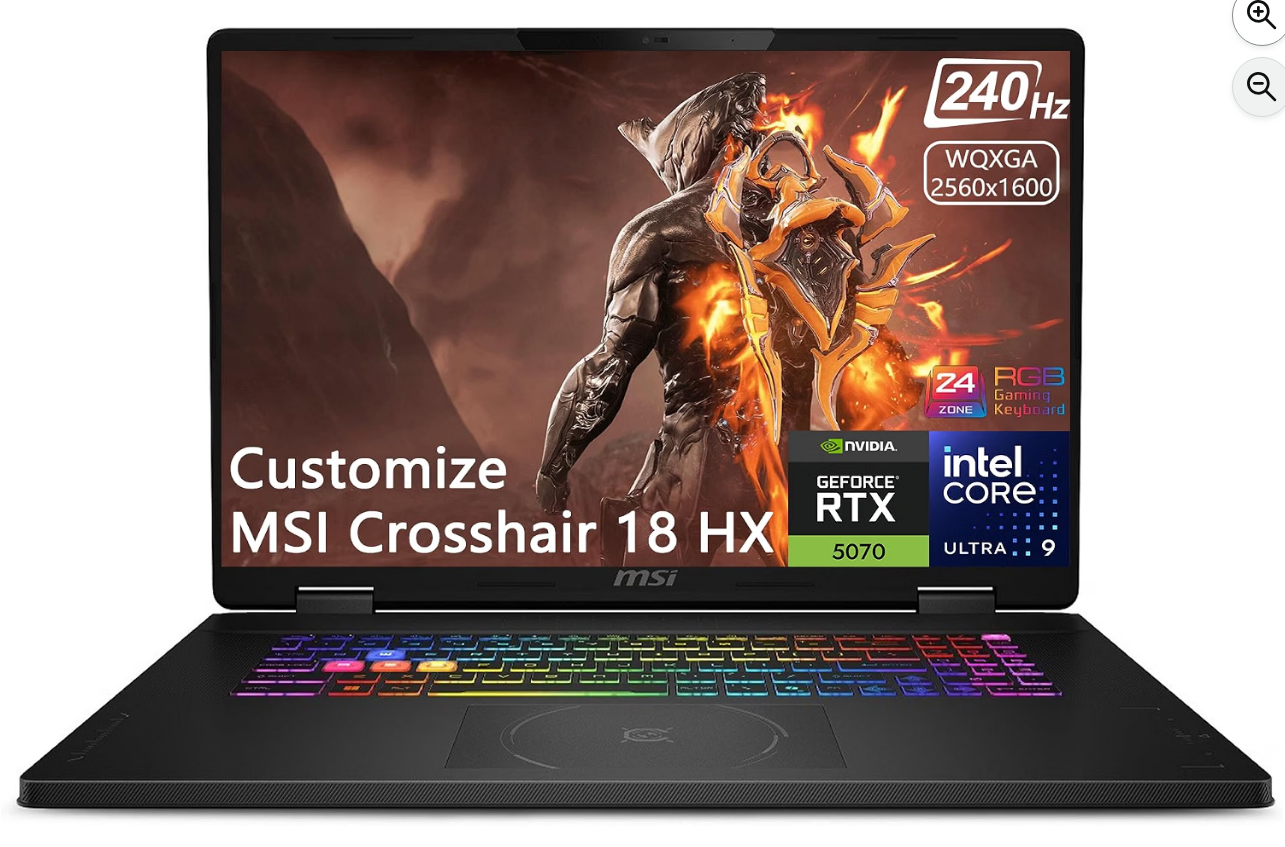
Ideally a laptop to play ultra competitively would be something like a 5060RTX-5070RTX such as the one shown below which can easily reach 300+ fps on performance mode at FHD resolution without compromising graphics quality significantly, we’ll review this laptop later.
Now…
Of course…
You can buy a cheap laptop, use Performance Mode and set almost everything to Low to get very high FPS and low input delay.
That’s an option too, but you’ll compromise A LOT of graphics quality and visibility.
Now…you don’t have to spend thousands of bucks to get low input delay + superb visibility.
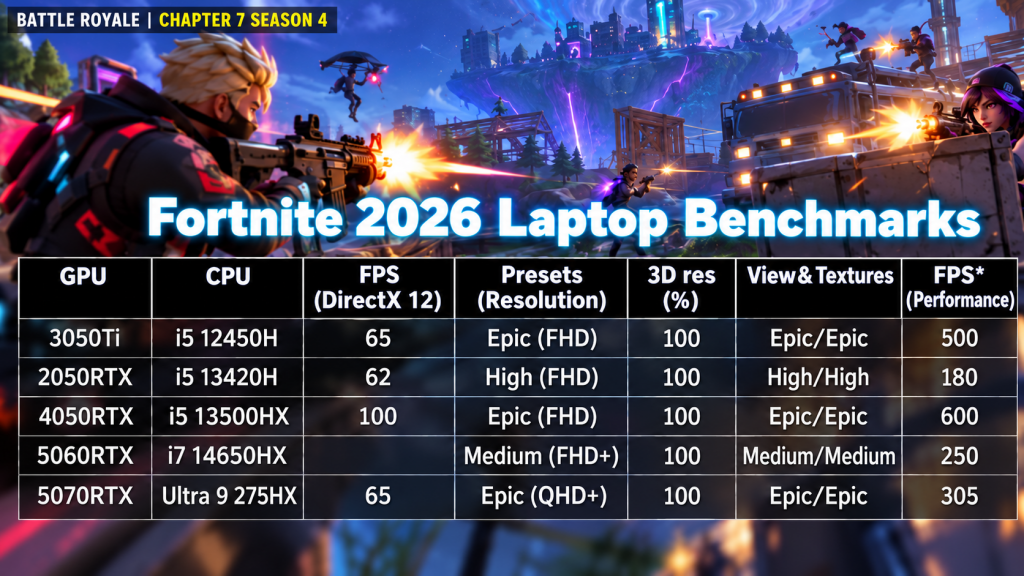
A mid-tier dedicated GPU is enough for high framerates at 1080p. Epic settings are much heavier, while Performance Mode can push FPS WAY higher.
If you don’t have a high budget…
Performance Mode still works FANTASTIC. You’ll get very high FPS while compromising some graphics quality.
Before we get to the best gaming laptops, lemme give you a few tips so you can also shop for a laptop on your own.
Recommended Laptop Specs for Fortnite
The following is based on the benchmarks listed in the last section.
GPU
If you want low input delay with decent visibility, these are the GPUs worth looking at. The higher you go, the less you need Performance Mode or very low settings.
NVIDIA: GTX 1650, RTX 2050 RTX 3050, RTX 4050 RTX 5050, RTX 4060, RTX 5060 RTX 4070, RTX 5070 RTX 5070 Ti+
AMD: RX 6600M RX 7600S, RX 7700S
GTX 1650 / RTX 2050: Epic Settings ~63 FPS in the older DX11/DX12 benchmarks. ~115 FPS Medium and ~187 FPS in Performance Mode.
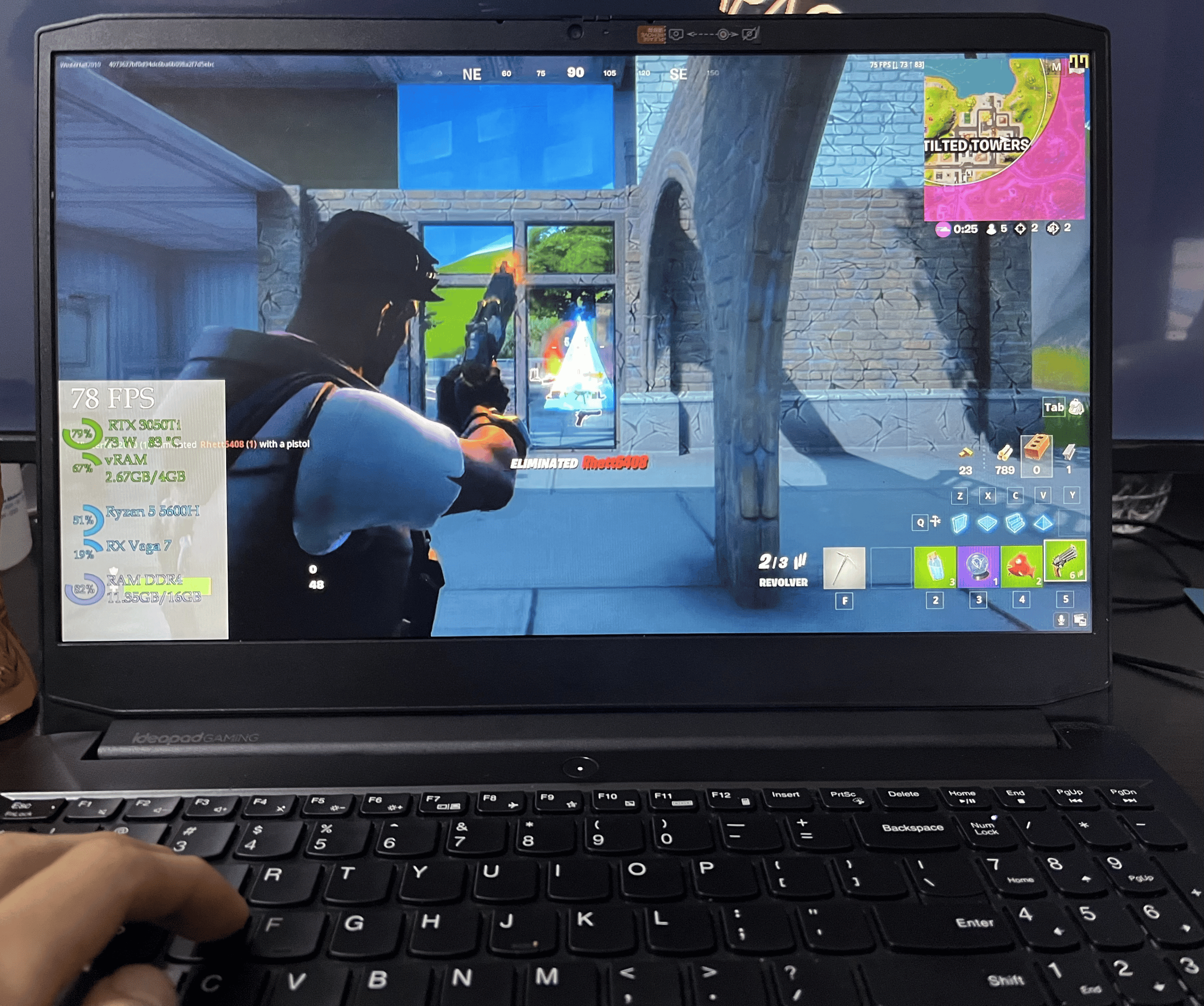
RTX 3050 / 3050 Ti: ~200-350 FPS in Performance Mode / ~80-90 FPS DX12 Epic in the benchmarks below.
RTX 4050 / RTX 5050: The current sweet spot for a Fortnite-focused gaming laptop. The RTX 4050-class benchmarks already show very high competitive FPS, while the newer RTX 5050 gives you 8GB VRAM.
RTX 4060 / RTX 5060: Better if you want QHD, higher graphics settings or you also play heavier games.
RTX 4070 / RTX 5070 and higher: Useful for QHD/QHD+, very high refresh rates or heavier games. Overkill if all you want is competitive Fortnite at 1080p.
Budget under $600?
Look for Intel Iris Xe / Arc or Radeon 760M / 780M-class integrated graphics. Performance Mode can still give you surprisingly high FPS at Low settings.
MUX Switch & Wattage
More GPU wattage can mean higher performance, but the difference isn’t always linear. Check my GPU Wattage or TGP guide for more details. A MUX Switch can also improve performance, especially at 1080p and very high FPS.
CPU
Fortnite is multi-threaded and uses several CPU threads. However, modern gaming CPUs already have plenty of cores, so strong per-core performance becomes more important when you’re chasing very high FPS.
Don’t just compare GHz numbers. Architecture, cache, power and cooling matter too, so benchmarks are much more accurate.
For an accurate estimate of which CPU is faster, check my post: Ryzen vs Intel CPU Performance Comparison.
RAM
8GB vs 16GB: 8GB can still run Fortnite, but 16GB is what I’d recommend in 2026. The game plus Windows, Discord, browsers and other background apps can easily make 8GB feel restrictive. You can see Fortnite RAM usage here.
Dual-Channel: dual-channel RAM can improve FPS, especially on integrated graphics and CPU-limited settings. Check my post on dual-channel RAM here to read more about it.
Display
FHD: Standard on gaming laptops and still the best resolution for competitive Fortnite on a budget.
QHD: Useful with RTX 4050/5050-class GPUs and above if you want sharper graphics and still have enough FPS.
144Hz / 165Hz: The sweet spot for most players.
240Hz+: Useful for competitive play if your CPU/GPU can actually sustain very high FPS. The gains get smaller as refresh rate increases, but they don’t suddenly become useless above 150Hz.
Top 5 Best Laptops For Fortnite 2026
The following five laptops cover everything from cheaper gaming systems to high-end QHD/QHD+ machines. If you want more options, check the benchmarks in the last section.
If your budget is lower, check my post on the best gaming laptops under $700.
Note: These laptops are available in the United States. If you can’t find them in your region, search for the model name or a laptop with similar CPU/GPU hardware.
1. HP Victus 15
Best Budget Laptop for Fortnite – RTX 3050
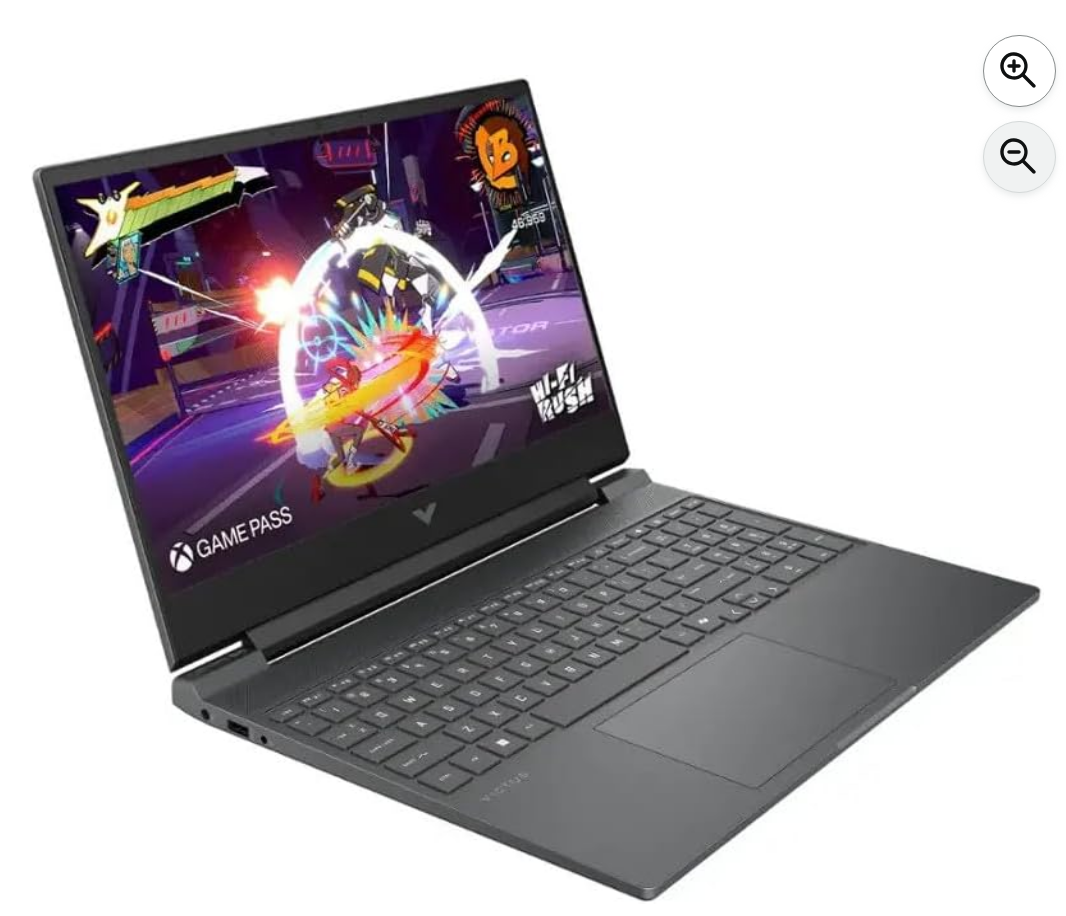
The best bang-for-your-buck Fortnite laptop right now is this HP Victus with the RTX 3050 6GB.
One big reason is simply the 2026 pricing. RTX 2050 laptops aren’t nearly as cheap as they used to be. The Acer Aspire 5 we discussed earlier is around $700, while this RTX 3050 Victus is around $769.
For roughly $70 more, I’d buy the RTX 3050 FIRST. It’s faster, has 6GB vRAM instead of 4GB and this Victus also gives you a proper 144Hz gaming display.
With this setup you can run Fortnite at High/Epic settings, or if you’re all about competitive play, switch to Fortnite Performance Mode and call it a day.
GPU: RTX 3050 6GB vRAM
RTX 3050 laptop GPUs can run at different wattages, so two laptops with the exact same GPU name don’t necessarily perform exactly the same.
Higher GPU wattage generally gives you more performance, assuming the laptop can keep temperatures under control.
If you crank Fortnite all the way up to Epic, you’re naturally going to push the GPU much harder than you would on competitive settings.
In my older RTX 3050Ti testing, for example, temperatures could get pretty high when the GPU was pushed hard for long periods. For long gaming sessions, I prefer using a balanced laptop performance profile unless I actually need maximum power.
Fortnite Laptop Benchmark: RTX 3050Ti
On my YouTube channel, I benchmarked Fortnite with a RTX 3050Ti paired with 16GB RAM. This is NOT the exact RTX 3050 6GB inside the Victus, so use these numbers as a reference rather than exact FPS for this laptop:
75 FPS on High Settings (DirectX 11). View Distance & Textures set to High with 100% 3D Rendering Resolution.
You can crank the framerate even higher by lowering the 3D resolution. And if you switch to Fortnite Performance Mode, the gains are insane:
CPU: Core i5-13420H
The old benchmarks used different Ryzen 5 and Core i5 CPUs. This Victus comes with the newer Core i5-13420H.
If you’re just gaming, Core i5 H-series CPUs are already plenty fast for Fortnite. If you’re streaming or running a lot of programs at the same time, multicore performance starts becoming more important.
That said, once you’re playing at High or Epic settings, the GPU becomes much more important, so don’t pay hundreds more just chasing a slightly faster CPU.
DDR4 vs DDR5
This Victus uses DDR4, not DDR5. DDR5 can give you a small performance bump in some situations, but it’s nowhere near enough to justify choosing a much more expensive laptop just for the RAM type.
I’d worry much more about getting 16GB RAM than whether the memory says DDR4 or DDR5.
Turbo Boost & Temps
Turbo Boost can push your CPU harder, but it also increases power consumption and temperatures. There’s no reason to disable it unless you’re actually having temperature problems.
Benchmarks Comparison
Here are some older RTX 3050Ti benchmarks. Notice how relatively small the differences are across CPUs when the GPU and graphics settings are similar:
[ScrollableTable]
| GPU | CPU | FPS | Rendering | 3D Res | Textures | View Distance | YouTube |
| RTX 3050Ti | Core i7-11800H | 70 | DirectX 12 | 100% | Epic | Epic | Framerated |
| RTX 3050Ti | Ryzen 5 5600H | 75 | DirectX 11 | 100% | Epic | Epic | IT NIC |
| RTX 3050Ti | Ryzen 5 5600H | 62 | DirectX 11 | 100% | Epic | Epic | LaptopStudy |
[/ScrollableTable]
RAM & Upgrades
This particular Victus comes with 8GB DDR4. Fortnite will run with that, but I’d upgrade to 16GB if possible, especially if you’re keeping Discord, browsers or streaming software open.
Running 16GB in dual-channel mode can also improve gaming performance. I have a guide on how to install RAM in dual-channel.
Storage is now a much more useful 512GB NVMe SSD instead of the old 256GB configuration, so you have enough room for Fortnite plus several other games.
Bonus: 144Hz Display
The Victus comes with a 144Hz FHD IPS display, which is exactly what you want for Fortnite.
For competitive gaming, especially when using Fortnite Performance Mode, framerates can easily go past 100 FPS. A high-refresh display actually lets you SEE those extra frames instead of being stuck at 60Hz.
[ScrollableTable]
| HP Victus 15 | |
| PROS | CONS |
|
|
[/ScrollableTable]
2. Acer Nitro V 15
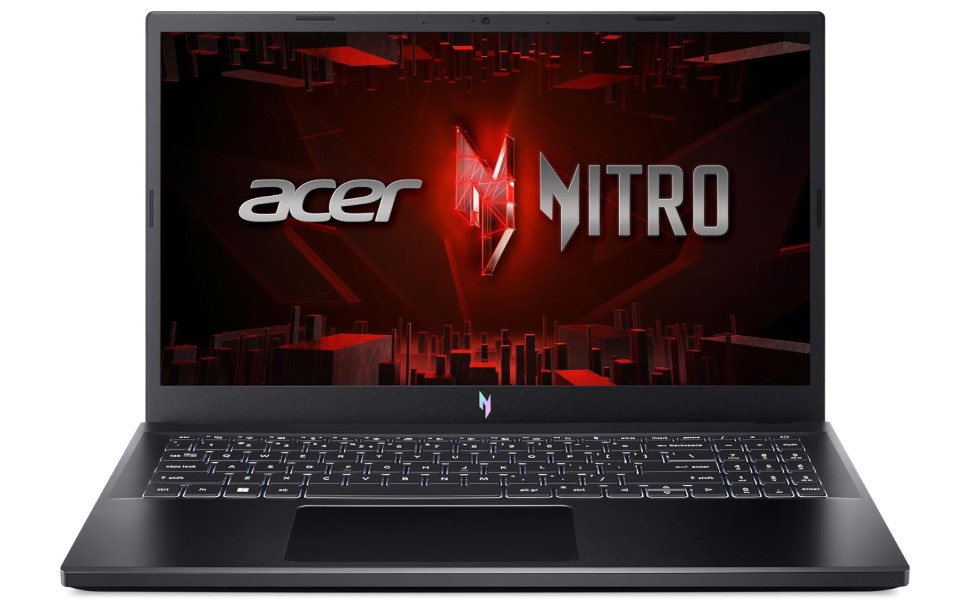
Best Gaming Laptop for Fortnite – RTX 4050
If you want to play competitively without relying entirely on Performance Mode and instead use DirectX 11 or DirectX 12 with high graphics settings, the RTX 4050 is where things start getting REALLY comfortable.
In 2026, this is also the next logical step above the RTX 3050 Victus. That laptop is around $769 while this Nitro V is around $900, so you’re paying roughly $130 more for a much faster GPU.
If Fortnite is the only game you play, the RTX 3050 already gives you plenty of performance. If you also play newer and more demanding games, the extra money for the 4050RTX makes much more sense.
GPU: RTX 4050 6GB
I’m recommending the RTX 4050 because it still offers one of the best price/performance jumps once you move above RTX 3050 laptops. You also usually get newer CPUs and DDR5 RAM with these machines.
The old RTX 3060 is still fast, especially the high-wattage versions, but in 2026 they’re mostly older or leftover-stock laptops. I wouldn’t go hunting for one unless the price is clearly lower than a 4050RTX laptop.
Wattage
The RTX 4050 in this Acer Nitro V runs at up to around 75W.
There are higher-wattage 4050RTX laptops out there, but the performance gains start shrinking as wattage goes higher. That’s one of the advantages of this GPU generation: you don’t necessarily need some huge 120W+ laptop to get good performance.
For more on this, check my laptop GPU wattage guide.
MUX Switch
This specific Nitro V isn’t really a laptop I’d buy because of a hardware MUX Switch. The main reason to buy it is simply the RTX 4050 + 165Hz combination at this price.
A MUX Switch can still improve performance on laptops that include one, especially at very high framerates, but it isn’t something I’d make the deciding factor here.
Fortnite Benchmarks: RTX 4050
The benchmark below uses an Acer Predator with an RTX 4050 running at a much higher wattage, so these are NOT exact benchmark numbers for this Nitro V. Use them as a reference for the GPU tier:
We already know Low settings and Performance Mode can push ridiculous framerates, so the more useful comparison is at very high graphics settings.
For comparison, here’s the older RTX 3060:
[ScrollableTable]
| GPU | TGP | CPU | FPS | Rendering | 3D Res. | View Distance | Textures |
| RTX 3060 | 130W | Ryzen 7 5800H | 110 | DirectX 11 | 100% | Epic | Epic |
| RTX 4050 | 125W | Core i5-13500HX | 100 | DirectX 11 | 100% | Epic | Epic |
[/ScrollableTable]
Neither benchmark is using DLSS. The 130W RTX 3060 comes out slightly ahead here, but again that’s an older high-power gaming laptop being compared against a different 4050RTX machine. Don’t treat this as a direct benchmark of the Nitro V.
CPU: Core i5-13420H
While the GPU is the most important factor once you crank Fortnite’s graphics settings up, don’t completely ignore the CPU.
The Core i5-13420H is already fast enough for this RTX 4050. More powerful CPUs matter more once you start lowering graphics settings and chasing extremely high competitive framerates.
DDR5 RAM
This laptop comes with DDR5 RAM, which is nice, but the bigger issue is capacity: this configuration only has 8GB.
I’d upgrade to 16GB before worrying about anything else. Fortnite plus Windows, Discord and browsers can easily make 8GB feel tight.
Display: 165Hz + 15.6-inch FHD
The newer Nitro V gives you a 15.6-inch FHD IPS display running at 165Hz.
That’s basically perfect for competitive Fortnite. Performance Mode can easily push past 165 FPS depending on your settings, while DirectX 11/12 with higher graphics still gives you enough performance to properly take advantage of a high-refresh display.
There’s no QHD panel here, but for competitive Fortnite I actually prefer FHD on an RTX 4050 anyway. You get much higher framerates and make better use of the 165Hz refresh rate.
RTX 3050 vs RTX 4050 in 2026
This is really the comparison I’d make today.
HP Victus RTX 3050 6GB: ~$769
Acer Nitro V RTX 4050 6GB: ~$900
For Fortnite alone, the RTX 3050 is already plenty fast and saves you roughly $130. If you’re also buying the laptop for newer AAA games though, I’d spend the extra money on the RTX 4050.
[ScrollableTable]
| Acer Nitro V 15 | |
| PROS | CONS |
|
|
3. Acer Aspire 5
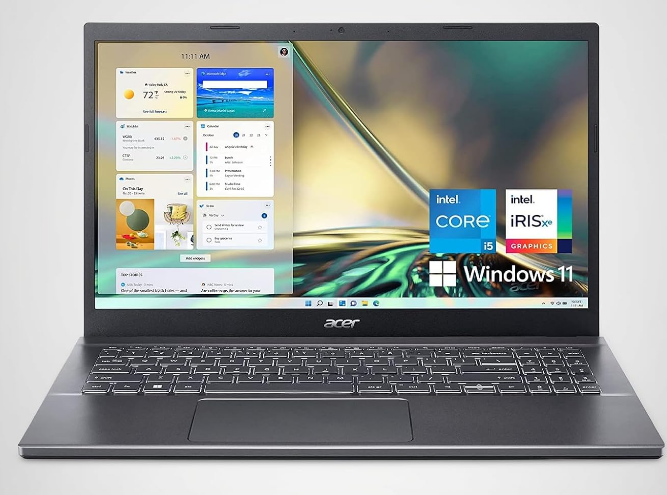
Cheap Laptop for Fortnite – RTX 2050
Time for the cheapest GPU tier on the list.
The problem in 2026 is that RTX 2050 laptops aren’t as cheap as they used to be. This Acer Aspire is around $700, while the RTX 3050 HP Victus we went over is around $769.
At only about $70 more, I’d buy the RTX 3050 FIRST. It’s faster and the Victus also gives you a proper 144Hz gaming display. The RTX 2050 starts making more sense again if you find this Acer on sale or the gap grows well beyond $100.
GPU: RTX 2050
A few years ago the GTX 1650 was the go-to budget GPU. The RTX 2050 basically replaced it in this price range and gives you similar entry-level dedicated-GPU performance plus access to newer RTX features such as DLSS in games that support it.
RTX 2050 vs GTX 1650
- Both normally come with 4GB vRAM.
- Gaming performance is in roughly the same general tier.
- The RTX 2050 supports DLSS in games that offer it.
Wattage
RTX 2050 laptops are usually designed around relatively low GPU power compared with larger gaming GPUs, which is one reason you can find the chip inside thinner laptops like this Aspire.
Exact GPU wattage varies by laptop though, so don’t assume every RTX 2050 will perform exactly the same.
MUX Switch?
A MUX Switch isn’t really something I’d expect or shop for in this budget RTX 2050 category. If features like that are important to you, you’re generally better off moving into RTX 3050/4050 gaming laptops anyway.
Fortnite Benchmark: RTX 2050 Laptop
That’s a different RTX 2050 laptop, NOT this exact Acer Aspire, so use 62 FPS as a reference point rather than a guaranteed result for this machine.
The table below is still useful because it shows just how much laptop configuration can matter with these budget GPUs. An older GTX 1650 machine can sometimes look surprisingly competitive depending on GPU power, CPU and Optimus/MUX configuration.
[ScrollableTable]
| GPU | CPU | FPS | Mode | 3D | Textures | View Distance | YouTube |
| RTX 2050 | Core i5-13420H | 62 | DirectX 11 / High | 100% | High | Far | KayahGamer |
| GTX 1650 | Ryzen 5 4600H | 48 | DirectX 11 / Epic | 100% | Epic | Epic | LaptopStudy |
| GTX 1650 | Core i5-9300H | 70 | DirectX 11 / Epic | 100% | High | Epic | LaptopStudy |
[/ScrollableTable]
CPU: Core i5-1240P
The Acer Aspire uses the Core i5-1240P. It’s not an H-series gaming CPU, but it’s still plenty for pairing with a budget GPU like the RTX 2050.
The benchmarks above also show why you shouldn’t judge Fortnite performance from CPU generation alone. With entry-level GPUs, GPU power limits and the rest of the laptop configuration can make a huge difference.
Display
The big disadvantage of this Acer Aspire compared with a real gaming laptop is the display. You’re not getting the 144Hz panel you usually get with something like the HP Victus.
That’s fine for High settings around the 60 FPS range, but if your goal is competitive Fortnite using Performance Mode and 100+ FPS, the 144Hz Victus makes MUCH more sense.
RTX 2050 vs RTX 3050 in 2026
Acer Aspire RTX 2050: ~$700
HP Victus RTX 3050 6GB: ~$769
At those prices, get the RTX 3050. You’re paying around $70 more for the faster GPU, 6GB vRAM and a 144Hz gaming screen.
I’d only pick the RTX 2050 Aspire first if it drops noticeably below the Victus, or if you specifically want the lighter, more normal-looking laptop instead of a heavier gaming machine.
[ScrollableTable]
| Acer Aspire 5 | |
| PROS | CONS |
|
|
[/ScrollableTable]
4. ASUS TUF Gaming F16
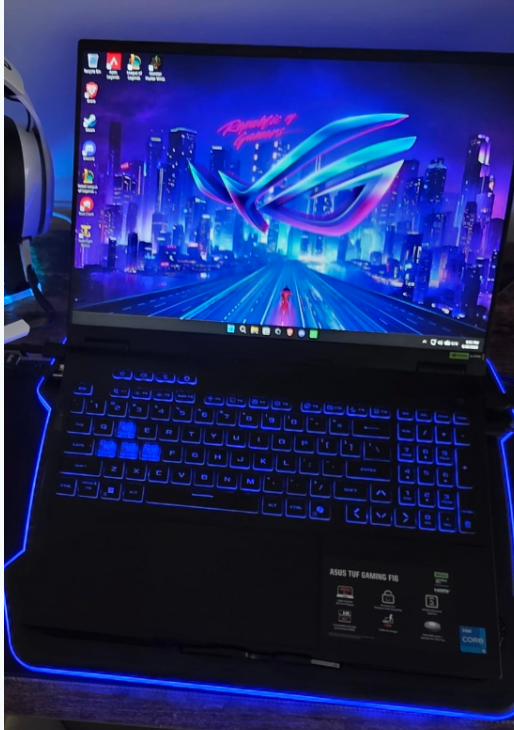
Competitive Fortnite Laptop – RTX 5050 115W
Now we’re getting into the more powerful and expensive Fortnite laptops.
This ASUS TUF F16 isn’t really about playing Fortnite with everything maxed out and admiring the graphics. The laptop makes much more sense for someone who’s VERY competitive and wants extremely high framerates while still keeping the game looking decent.
In other words: at this level, staying alive, seeing the enemy first and winning the fight matter more than shadows, reflections and pretty effects.
GPU: RTX 5050 115W
This ASUS TUF comes with the newer RTX 5050 Laptop GPU running at up to 115W.
That’s a pretty high power limit for this GPU, which is exactly what I want in a gaming laptop. Remember that laptop GPUs with the same name can perform differently depending on their TGP.
The RTX 5050 is already WAY more GPU than you need if you’re just going to use Fortnite Performance Mode at the lowest settings. You’re paying for the ability to keep much better image quality while still pushing competitive framerates.
NVIDIA Advanced Optimus
This laptop also comes with NVIDIA Advanced Optimus.
That’s important on a machine like this because the system can switch the internal display over to the dedicated GPU when gaming instead of forcing frames through the integrated graphics path.
You can read more about how this works in my MUX Switch and Optimus guide.
Fortnite Benchmark: RTX 5060 – Competitive Settings
I only want to use ONE benchmark here because it better represents what this section of the article is about: very high competitive framerates.
[ScrollableTable]
| CPU | GPU | Settings | FPS | Rendering |
| Core i7-14650HX | RTX 5060 | Performance / 1200p / Medium | ~250 FPS | DirectX 12 |
[/ScrollableTable]
IMPORTANT: that’s an RTX 5060 benchmark, not this exact RTX 5050 ASUS TUF. The CPU is also a faster Core i7-14650HX, so I’m NOT saying this laptop will automatically give you 250 FPS.
I’m using the benchmark to show what this kind of setup is targeting.
Notice that we’re not testing QHD and we’re not testing Epic settings either. It’s 1200p at Medium settings because the whole point here is ultra-competitive gameplay.
At that point visual quality becomes secondary. You still want the game to look good enough to clearly identify players and objects, but you’re not trying to make Fortnite look like a cinematic game.
You want high visibility + very high FPS + low latency. That’s it.
Why No QHD or Epic Benchmark?
Because that’s not what I’m recommending this particular setup for.
If your goal is purely to win competitive Fortnite matches, running QHD resolution and Epic graphics just adds GPU load you don’t need.
This is one of the few situations where I’d rather have 250 FPS at Medium than 90-120 FPS with every visual effect cranked to the maximum.
Yes, Epic looks better. But when somebody jumps into your screen and starts building/shooting, you’re probably not going to stop and admire the shadows.
CPU: Core i5-13450HX
The ASUS TUF uses the Core i5-13450HX.
Don’t get fooled by the Core i5 name. The HX designation is important here because this is a high-performance laptop CPU, not the type of low-power Core i5 you’d find in a thin school laptop.
CPU performance becomes particularly important when you’re trying to push extremely high Fortnite framerates. Once you lower the graphics settings enough, the GPU has less work to do and the CPU becomes increasingly important.
The benchmark uses the faster Core i7-14650HX, which is another reason you should NOT expect the exact same 250 FPS number from this Core i5 configuration.
Display: 16-inch FHD+ 165Hz
The display is 16-inch FHD+ at 165Hz with a 16:10 aspect ratio.
FHD+ means you’re working around the same 1200p resolution used in the benchmark, which is actually a VERY good fit for this type of competitive Fortnite setup.
The only limitation is that the internal panel is 165Hz. If the laptop is producing well above 200 FPS, the display obviously cannot show all 200+ individual frames every second.
Still, 165Hz is already a massive jump from 60Hz and perfectly suitable for competitive play.
RAM & Storage
You get 16GB DDR5 RAM right out of the box, which is exactly where I’d stop for Fortnite.
There’s no reason to pay extra for 32GB or 64GB just for gaming. 16GB is enough for Fortnite plus Discord, browsers and your normal background programs.
Storage is a 512GB PCIe Gen 4 SSD. That’s enough to get started, although you’ll probably want more eventually if this is also your main laptop for large AAA games.
Who Is This Laptop For?
At $1,249, this definitely isn’t my budget Fortnite recommendation.
The RTX 3050 and RTX 4050 laptops above cost much less and already run Fortnite extremely well.
This ASUS TUF makes sense if you’re willing to spend more because you want a newer RTX 5050, a high-power 115W implementation, Advanced Optimus and a machine designed around high-FPS competitive gaming.
If your idea of Fortnite is 1200p, Medium settings and squeezing every possible frame out of the machine because winning matters more than graphics, THIS is the kind of laptop I’d look at.
[ScrollableTable]
| ASUS TUF Gaming F16 | |
| PROS | CONS |
|
|
[/ScrollableTable]
5. MSI Crosshair 18 HX AI
High-End Fortnite Laptop – RTX 5070
This is the point where we’re WAY beyond what you actually need just to run Fortnite.
The RTX 5070 makes sense if you want one laptop that can do basically everything: 300+ FPS competitive Fortnite, QHD+ gaming and much more demanding AAA games.
There are several CPU configurations of this MSI, including Core Ultra 9 and Ryzen 9 versions. The link above points to the Core Ultra 9 275HX configuration, which is convenient because that’s the exact CPU used in the Fortnite benchmarks below.
GPU: RTX 5070 8GB GDDR7
The RTX 5070 is complete overkill if you’re only going to play Fortnite at regular FHD settings.
You’re buying this GPU either because you want extremely high competitive framerates or because you also want to play at the laptop’s native 2560 × 1600 QHD+ resolution with much higher graphics settings.
The nice thing is that this benchmark gives us BOTH sides of the story: maximum competitive FPS and maximum image quality.
Fortnite Benchmarks: RTX 5070 + Core Ultra 9 275HX
[ScrollableTable]
| CPU | GPU | Resolution | Graphics | Settings | Average FPS |
| Core Ultra 9 275HX | RTX 5070 | 1600p (QHD+) | Performance | Low | 305 FPS |
| Core Ultra 9 275HX | RTX 5070 | 1200p (FHD+) | Performance | Low | 335 FPS |
| Core Ultra 9 275HX | RTX 5070 | 1600p (QHD+) | Epic + DLSS | Epic | 65 FPS |
[/ScrollableTable]
Performance Mode is where things get ridiculous.
That’s the number I find more interesting because it’s running at the laptop’s native 2560 × 1600 resolution and still averaging over 300 FPS.
Dropping to FHD+ gives you even more:
That’s only another 30 FPS though. At this point I’d personally stick with QHD+. You’re already over 300 FPS and the higher resolution gives you a noticeably sharper image.
QHD+ Epic + DLSS
Then there’s the complete opposite way of playing Fortnite:
This is obviously NOT the configuration I’d use if I was trying to win competitive matches.
It’s there if you want Fortnite looking as good as possible. You’re basically trading the insane 300+ FPS competitive numbers for much higher image quality and all the eye candy.
So this laptop can go from ~65 FPS QHD+ Epic all the way to 305 FPS QHD+ competitive settings. That’s what you’re paying for here: options.
QHD+ vs FHD+
For this RTX 5070, I honestly don’t see much reason to play Fortnite at 1200p unless you absolutely need every last frame.
You’re getting 335 FPS at FHD+ versus 305 FPS at QHD+. That’s not a huge sacrifice considering the jump in resolution.
For me, QHD+ Performance Mode is the sweet spot here. You still get ridiculous competitive performance but you’re actually taking advantage of the 1600p display you paid for.
CPU: Core Ultra 9 275HX
This benchmark uses the Core Ultra 9 275HX, which is also the CPU in the configuration linked above.
That matters a lot once you’re chasing 300+ FPS. At low competitive settings, you’re intentionally reducing the workload on the GPU, so CPU performance starts becoming much more important.
You do NOT need a Core Ultra 9 just to play Fortnite. The RTX 3050 and 4050 laptops above already prove that. But if the goal is several hundred FPS, this is exactly the kind of CPU you want paired with the RTX 5070.
Ryzen 9 Benchmark Coming Soon
There’s also a Ryzen 9 version of this MSI, and I actually own that laptop.
I’ll be running the same Fortnite tests on it so we can compare the Ryzen 9 version directly against these Core Ultra 9 numbers instead of guessing from unrelated benchmarks.
Display: 18-inch QHD+ 240Hz
The 18-inch QHD+ 240Hz display is exactly what makes this GPU useful.
At QHD+ competitive settings you’re averaging 305 FPS, so the 240Hz panel can actually be pushed to its limit.
Yes, the GPU can generate more than 240 FPS, but the display can show up to 240 frames per second. That’s already WELL beyond the 144Hz and 165Hz panels on the cheaper laptops.
RAM
The configuration starts at 16GB DDR5, which is all you need for Fortnite.
There are also 32GB and 64GB configurations, but don’t buy those expecting higher Fortnite FPS. They’re useful if you’re also doing heavier multitasking, content creation or workstation-type work.
Who Should Buy This?
Not someone just looking for a Fortnite laptop.
You can spend WAY less and still get excellent competitive performance.
This MSI makes sense if you want QHD+ competitive Fortnite at 300+ FPS, an 18-inch 240Hz display and enough GPU power to also run much more demanding games at high resolutions.
[ScrollableTable]
| MSI Crosshair 18 HX AI | |
| PROS | CONS |
|
|
[/ScrollableTable]
How To Buy The Best Laptop For Fortnite
Gaming Laptop Requirements for Fortnite
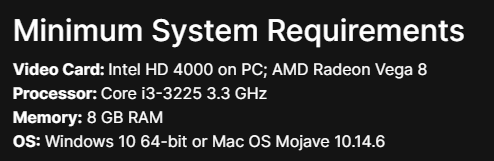
The screenshot above is from the older requirements page. The current 2026 requirements are summarized below.
Epic’s current PC requirements are still very modest. The official minimum calls for an Intel Core i3-3225, Intel HD 4000 / AMD Radeon Vega 8-class graphics and 8GB RAM. The recommended level moves to a Core i5-7300U or Ryzen 3 3300U, GTX 960 / Radeon R9 280-class graphics, 16GB RAM and an NVMe SSD.
For Epic Quality, Epic lists an RTX 3070 or Radeon RX 6700 XT-class GPU with at least 8GB vRAM, plus a Core i7-8700 / Ryzen 7 3700X-class CPU and 16GB RAM. Those are desktop references, so the rest of this guide uses actual laptop hardware and laptop benchmarks.
Anyways, the focus of this section is not simply meeting the minimum. It’s getting the highest FPS and lowest practical input delay for your budget so you can play competitively.
Recommended Requirements for Fortnite
To do this we are going to check out the benchmarks of several laptops with different GPUs & CPU set ups. Starting with low performance set ups.
Now to save you time, we’ll do this in two parts:
A) If your budget is under 500 dollars:
- Read part A which focuses on the CPU. Reason? Because a good CPU means a good integrated graphics card (they come in pairs).
B) If your budget is over 550 dollars:
- Skip to part B). You can afford a dedicated GPU, so the GPU becomes the main priority. The CPU still matters once you start chasing very high competitive FPS.
A) Fortnite Laptops: Under 500 USD
1. CPU: Must be recent
At this budget, the main thing to watch is the integrated GPU. Dedicated-GPU deals do occasionally fall below $500, but most new laptops here still rely on graphics built into the processor.
That means you are really choosing the CPU and iGPU together. For Fortnite, the difference between a weak iGPU such as Radeon 610M and a much faster one such as Radeon 760M, Radeon 780M or Intel Arc can be HUGE.
Integrated graphics are basically the ‘default graphics card’ when you have no dedicated GPU.
As a rule of thumb, newer CPUs usually bring newer integrated graphics, but do NOT buy by generation name alone. AMD’s Ryzen 7000 naming is the perfect example: a Ryzen 5 7520U only has Radeon 610M graphics, while a Ryzen 5 7640U has the much faster Radeon 760M.
Below are the CPUs and integrated GPUs you’re most likely to run into now.
Intel
| CPU | Integrated GPU | 2026 Position |
| Core i3-1215U | Intel UHD 64 EUs | Budget |
| Core i3-1315U | Intel UHD 64 EUs | Budget |
| Core 3 100U | Intel Graphics 64 EUs | Budget / newer naming |
| Core i5-1135G7 | Intel Iris Xe 80 EUs | Older mid-range |
| Core i5-1345U | Intel Iris Xe 80 EUs | Older mid-range |
| Core 5 120U | Intel Graphics 80 EUs | Current mainstream U-series |
| Core Ultra 5 125H | Intel Arc, 7 Xe-cores | Much faster iGPU |
| Core Ultra 5 225H | Intel Arc 130T, 7 Xe-cores | Newer Series 2 |
| Core Ultra 7 255H | Intel Arc 140T, 8 Xe-cores | Fastest Intel iGPU tier here |
AMD
| CPU | Integrated GPU | 2026 Position |
| Ryzen 3 5300U | Radeon Vega 6 | Older budget |
| Ryzen 3 7320U | Radeon 610M | Budget but weak iGPU |
| Ryzen 5 5500U | Radeon Vega 7 | Older value |
| Ryzen 5 7520U | Radeon 610M | Newer name, weak iGPU |
| Ryzen 5 7640U | Radeon 760M | Fast iGPU |
| Ryzen 5 8640U / 8645HS | Radeon 760M | Fast iGPU |
| Ryzen 5 240 | Radeon 760M | Current value option |
| Ryzen 7 8845HS / Ryzen 7 260 | Radeon 780M | Very fast iGPU |
| Ryzen AI 7 350 | Radeon 860M | AI 300-series |
| Ryzen AI 7 450 | Radeon 860M | Newest AI 400-series |
| Ryzen AI 9 HX 370 | Radeon 890M | AI 300-series high-end |
| Ryzen AI 9 HX 470 / HX 475 | Radeon 890M | Newest AI 400-series high-end |
- The tables above are grouped by Intel and AMD. Within each brand, pay more attention to the actual iGPU than the CPU name alone.
- Use the third column as the quick guide. The exact iGPU matters more than whether the processor says Core i5, Core Ultra 5, Ryzen 5 or Ryzen 7.
- The Radeon 610M models are the weak links. They can still run Fortnite in Performance Mode, but they are MUCH slower than Radeon 760M/780M-class graphics.
- Core Ultra 7, Ryzen 7 and Ryzen AI 7 laptops can have excellent integrated graphics, but once the price gets close to a gaming laptop with an RTX GPU, the dedicated-GPU laptop usually makes more sense for Fortnite.
- Of course if they are under 500 dollars they’re a good deal.
Older CPUs
The table below is kept as a historical reference for older laptops. These chips can still run Fortnite at reduced settings, but in 2026 I would favor the newer CPUs/iGPUs in the tables above unless the used laptop is VERY cheap.
[ScrollableTable]
| CPU | GPU |
| i3 8130U |
Intel UHD 620
|
| i3 1005G1 |
Intel UHD G1
|
| Ryzen 3 4300U | RX Vega 5 |
| Ryzen 3 3200U | RX Vega 3 |
[/ScrollableTable]
i) Core i3 & Ryzen 3 Benchmarks ($300-400 Laptops)
[ScrollableTable]
| CPU | Mode(Presets) | FHD/HD | Texture/Mesh | View D. | FPS | Link |
| Ryzen 3 3300U | Performance(Alpha) | 720p | Low | Near | 60 | Kostan |
| Ryzen 3 3300U | Direct x11(low) | 720 | Low | Near | 43 | Rojo |
| Ryzen 3 3300U | Direct x11 (low) | 720 | Low | Near | 45 | Fosterwing |
| Ryzen 3 4300U | Direct x12(low) | 1080p | Low | Near | 60 | Smartics |
| Ryzen 3 4300U | Direct x11(low) | 720p | Low | Near | 85 | Khairy |
| Ryzen 3 5300U | Performance(Alpha) | 1080p | Low | Medium | 70 | Kostan |
| Ryzen 3 5300U | Performance (Beta) | 1080p | Low | Near | 130 | Viper87 |
| Ryzen 3 7320U | Performance (Low) | 1080p | Low | Near | 422 | Kostan |
| Core i3 10100U | Direct x11(low) | 720p | Low | Near | 50 | Facun 234 |
| Core i3 10100U | Performance(Alpha) | 720 | Low | Near | 85 | Facun 234 |
| Core i3-1115G4 | Direct x11(low) | 720 | Low | Near | 65 | Wythee |
| Core i3-115G4 | Performance(Alpha) | 720p | Low | Near | 431 | CRSNTBENCH |
| Core i3 1215U |
Performance(Low) | 1200p | Low | Near | 70 | PC/HW |
| Core i3 1315U |
Performance(Low) | 1080p | Low | Near | 82 | Hubwood |
[/ScrollableTable]
1.Framerates are low due to 3D resolution set to 100%. Recommended to lower down 3D resolution to 50-66% if going for this old CPU
2. Low framerates are caused by the lack of GPU power: 610M is a very slow iGPU.
- These are the cheapest useful CPUs in the historical benchmark set. In 2026, don’t judge Ryzen by the first digit alone: the Ryzen 3 7320U is newer than the 5300U but its Radeon 610M iGPU is much weaker. Check the actual integrated GPU before buying.
- In order for these laptops to reach the framerates in the table:
- Graphics must be set to Performance mode
- With texture and meshes to low.
- You compromise some visibility in exchange for better input delay which is far more important for the game.
ii) Core i5 & Ryzen 5 BenchMarks ($400-500 Laptops)
[ScrollableTable]
| CPU | Mode(Presets) | Resolution | Textures & Meshes | View Distance |
FPS | Youtube Channel |
| Ryzen 5 3500U | Direct X11(Low) | 720p | Low/Near | Near | 100 | Kostan |
| Ryzen 5 4500U | Performance (Alpha) | 1080p | Medium/Low | Far | 65 | CRNSTBENCH |
| Ryzen 5 5500U | Direct X11(Low) | 1080p | Medium/Low | Medium | 101 | EvoTech |
| Ryzen 5 7250U |
Performance | 1080p | Low | Near | 42 | Viztorhugo |
| Core i5-1035G4 | Direct x11(low) | 720 | Low/Low | Near | 35* | Technoriales |
| Core i5-1035G4 | Performance (Alpha) | 1080p | Low/Low | Near | 50** | Viper87 |
| Core i5-1115G7 | Direct x11(High) | 1080 | High/High | Far | 35 | Intel Iris XE |
| Core i5 1230U |
Performance | 1080 | Low | Near | 85 | Scorpion Gaming |
| Core i5 1345U* |
— | — | — | — | — | — |
[/ScrollableTable]
*This is an older benchmark set. Newer Core 5/Core Ultra 5 and Ryzen 5 models are listed in the 2026 hardware tables above, but I am leaving the original benchmark results untouched.
**3D resolution is 75%. Display resolution is FHD (1080p) too.
- If your budget is around $450-500, a Core i5/Core 5/Ryzen 5-class laptop usually gives you more headroom than the cheapest Core i3/Ryzen 3 options.
- Just remember that the iGPU matters: Radeon 760M/780M and Intel Arc are far stronger than UHD or Radeon 610M graphics.
- Avoid weak Ryzen 5 models that use Radeon 610M graphics, especially the Ryzen 5 7520U. Other Ryzen 7000-series chips such as the Ryzen 5 7640U are completely different and use the MUCH faster Radeon 760M.
- Some of these benchmarks show poor performance because High textures & Meshes were used in DirectX 11 mode.
- 35-40 fps is very low for competitive gaming.
- You want to set all settings to low on DirectX 11/12 or set it to Performance Mode(Low), whichever gets you +60.
- Note that the fps numbers may not be exactly accurate because some of these benchmarks were taken with different 3D resolution settings. Some had the bar at 66% and others as high as 85%.
- I recommend you set it as low as possible while keeping view distance as high as possible before dropping to below 60fps.
iii) Core i7 & Ryzen 7 BenchMarks
[ScrollableTable]
| CPU | FPS | Mode(Presets) | FHD | Textures/Meshes | View D. | Link |
| Core i7 10700U | 28* | Performance(Alpha) | 1080p | High/High | Epic | CRSTNBENCH |
| Core i7 10700U | 62 | Performance(Alpha) | 1080p | Low/Low | Epic | StediGaming |
| Core i7-1165G7 | 55* | Direct x11(low) | 1080p | Low/Low | Epic | legos 45 |
| Core i7-1165G7 | 61 | Performance(Alpha) | 1080p | High/High | Far | TechMedia |
| i7 1255U | 65 | Performance (Low) | 1080p | Low/Low | Near | Carry Bjorn |
| i7 1335U | 101 | Performance(Low) | 720p | Low/low | Near | Adian |
| Ryzen 7 3700U | 82 | Direct X11(Low) | 1080p | Low/Low | Near | NerrZul |
| Ryzen 7 4800U | 62 | Direct X11(Low) | 1080p | Low/Low | Far | CRSTNBENCH |
| Ryzen 7 5700U | 65 | Direct X11(Custom) | 1080p | Low/Low | Far | TE Benchmark |
| Ryzen 7 5700U | 70 | Performance(Beta) | 900p | Low/Low | Low | ALABA |
| Ryzen 7 7730U | 72 | Performance | 1080p | Low/Low | Epic | Stedi Gaming |
[/ScrollableTable]
Core i7/Ryzen 7-class CPUs give you more CPU headroom, but the old benchmark table should not be read as a simple i7 > i5 rule because the tests use different resolutions and settings.
For Fortnite on integrated graphics, the iGPU matters just as much as the CPU badge. A Ryzen 7 with Radeon 780M or a Core Ultra 7 with Arc graphics can be dramatically faster than an older Ryzen 7/Core i7 with Vega or Iris Xe.
If the laptop is getting close to gaming-laptop pricing, though, prioritize a dedicated GPU instead of paying extra only for the CPU name.
2. RAM: 16GB Recommended
Epic still lists 8GB as the minimum, but its current recommended specification is 16GB. For a new laptop in 2026, 16GB is the amount I would buy, especially if you play competitively with Discord, a browser, recording software or other programs open.
RAM for Integrated GPUs
RAM matters even more when you’re using integrated graphics because the iGPU shares system memory with the CPU. The important part is not simply having more capacity; memory bandwidth and the memory configuration can also have a BIG effect on iGPU performance.
If the laptop is upgradeable, moving from a poor 8GB configuration to 16GB is one of the best upgrades you can make. You can see how to upgrade laptop RAM here.
Dual-Channel Mode
On laptops using upgradeable DDR4/DDR5 memory, two matching modules can increase memory bandwidth and help gaming performance, especially with integrated graphics. Modern LPDDR5/LPDDR5X designs work differently and are usually soldered, so don’t assume every laptop needs two removable sticks.
DDR4 vs DDR5
DDR5 offers more bandwidth than DDR4, but don’t buy a slower laptop just because it says DDR5. CPU, GPU, power limits and cooling matter much more. The memory advantage is most noticeable when the integrated GPU depends heavily on system-memory bandwidth.
B) Fortnite Laptops: $550 and Up
1. GPU: Must be Dedicated Graphics
Once you move into gaming-laptop prices, the dedicated GPU becomes the MOST important part for Fortnite performance.
The CPU still matters when you are chasing 200-300+ FPS in Performance Mode, but for higher visual settings and higher resolutions the GPU has the biggest impact.
Before we go over the dedicated GPUs and their performance with fortnite, let’s make it clear what the settings on fortnite mean.
Rendering Mode: Performance vs Direct X11 vs Direct X12
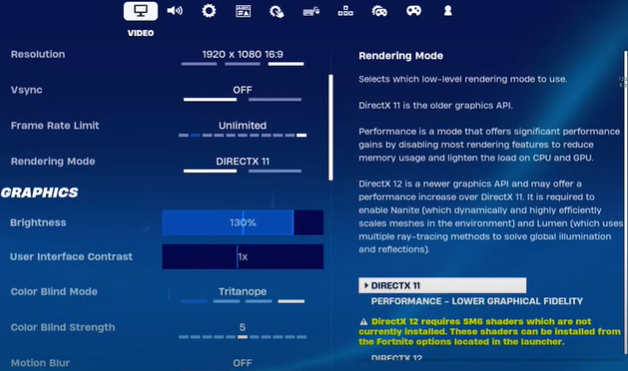
Performance Mode:
This is still the mode to use if your priority is maximum FPS and the lowest practical input delay. It cuts visual quality but can push even mid-range laptops into very high framerates.
DirectX 11 & DirectX 12: These keep more of Fortnite’s visual effects. On modern RTX hardware, DirectX 12 makes the most sense when you want Epic settings, DLSS and the newer rendering features. DirectX 11 is still useful as a fallback if a particular system runs more smoothly with it.
Which Rendering Mode is Best for Fortnite? It depends on your hardware and whether you care more about FPS or visual quality.
Integrated graphics and weak dedicated GPUs should generally use Performance Mode. RTX 4050/5050-class and faster laptops can use DirectX 12 comfortably when you are willing to trade some FPS for much better graphics.
2026 Dedicated GPU Guide
Before the historical benchmark groups below, here’s the current 2026 laptop-GPU map. The older benchmark tables are still useful because they show real Fortnite performance; this table tells you where the newer GPUs fit.
[ScrollableTable]
| 2026 Tier | NVIDIA Laptop GPUs | AMD Laptop GPUs | Best Use in Fortnite |
| Legacy / used | MX450, MX550, GTX 1650 | RX 560X, RX 5500M | Only if very cheap; Performance Mode |
| Budget gaming | RTX 2050, RTX 3050 | RX 7600S | 1080p competitive / Medium-High |
| Current sweet spot | RTX 4050, RTX 5050 | RX 7700S | 1080p high-FPS; 5050 adds 8GB VRAM |
| Upper mid-range | RTX 4060, RTX 5060 | RX 7800M | 1080p very high refresh / 1440p |
| High-end | RTX 4070, RTX 5070 | RX 7900M | QHD/QHD+, high refresh, Epic with upscaling |
| Extreme | RTX 5070 Ti, RTX 5080, RTX 5090 | — | Overkill for competitive 1080p; 1440p/4K + max visuals |
[/ScrollableTable]
i) MX 150, MX250 Legacy Benchmarks (Older / Used Laptops)
| NVIDIA | Cores | vRAM | Speed |
| MX150 | 384 | 2GB-4GB | 1532 |
| MX250 | 384 | 2GB-4GB | 1582 |
| MX230 | 256 | 2-4GB | 1519 |
[ScrollableTable]
| Name | Shaders | vRAM | Speed | Equivalent |
| Radeon 610 | 320 | 2GB | 1030 | Intel UHD 620 |
| Pro RX 555X | 768 | 2GB | 855 | MX150/MX250 |
| RadeonRX 540 | 512 | 4GB | 1219 | ~MX150/MX250 |
| Radeon RX 550 | 640 | 4GB | 1287 – 1476 | ~MX250 |
[/ScrollableTable]
These MX150/MX250-class GPUs are legacy hardware now. I would only consider them in a VERY cheap used laptop because modern integrated graphics can match or beat this class of GPU. If you want dedicated graphics in 2026, look for at least an RTX 2050/3050-class deal, or preferably an RTX 4050/5050 if the budget allows it.
ii) MX 350, MX 450, MX 550 & GTX 1050 Legacy Benchmarks
[ScrollableTable]
| NVIDIA | Cores | vRAM | Speed |
| MX350 | 640 | 2GB | 1354 |
| MX450 | 896 | 2GB | 1580 |
| MX550 | 1024 | 2GB | 1320 |
| 1050 | 640 | 2GB-4GB | 1493 |
[/ScrollableTable]
[ScrollableTable]
| AMD | Shaders | vRAM | Speed | Equivalent |
| Radeon RX 560X | 1024 | 4GB | 1172 – 1275 | 1050GTX |
[/ScrollableTable]
[ScrollableTable]
| Hardware | Direct X12 | Performance | Youtube | |||
| Graphics | Processor | Low | Med | High | +Epic Distance | |
| MX450 | Core i7-1165G7 | 115-150 | – | 45-55 | — | Laptopmedia |
| MX450 | Ryzen 7 5800U | — | – | — | 112 | Carry Bjorn |
| MX550 | i5 1240P | 68-90 | ??? | Zax Game | ||
| 1050GTX | Core i5 8300H | — | — | 108 | Tello Games | |
| 1050GTX | Core i5 7300HQ | — | — | 101 | FS Informatica | |
| MX350 | Core i5 10210U | 80fps | — | — | its Spartan117 |
|
[/ScrollableTable]
**For more details on settings check the youtube links. Rendering resolution as well as texture settings may change.
- MX350/MX450/MX550 and GTX 1050 laptops are now legacy choices. They are still useful if you’re buying used or getting a very cheap clearance machine, but a discounted RTX 2050/3050 laptop is a much better target if the price is close.
- The benchmark data below is still valuable because it shows what these older GPUs can actually do in Fortnite.
Warning: Don’t compare two laptops only by the CPU name in these old tests. GPU wattage, MUX/Optimus behavior, RAM and the Fortnite version can all change the result.
Competitive Settings: Legacy MX GPUs
Performance Mode is the safest choice now. Keep View Distance as high as you can while lowering textures, meshes and effects until the frame rate stays comfortably above your display refresh target.
iii) GTX 1650 & RTX 2050 Budget Benchmarks
[ScrollableTable]
| NVIDIA | CUDA Cores | vRAM | 2026 Status |
| GTX 1650 | 1024 | 4GB | Legacy / used |
| RTX 2050 | 2048 | 4GB | Budget |
| RTX 3050 | Varies by version | 4GB or 6GB | Budget |
| RTX 4050 | 2560 | 6GB GDDR6 | Discounted/current budget gaming |
| RTX 5050 | 2560 | 8GB GDDR7 | Newest entry RTX 50 option |
[/ScrollableTable]
[ScrollableTable]
| GPU | CPU | FPS(avg) | Mode(Presets) | 3D Resolution | Textures & Meshes | View D. | Youtube |
| 1650GTX | Core i5 10300H | 180[1] | Direct X12(Low) | 90% | Low | Near | ShadowSeven |
| 1650GTX | Core i5 10300H | 68[1] | Direct X12(High) | 100% | High | Far | ShadowSeven |
| 1650GTX | Core i5 10300H | 50[1] | Direct X12(Epic) | 100% | Epic | Epic | ShadowSeven |
| 1650GTX | Core i5 9300H | 113 | Direct X11(Med) | 66% | Medium | Medium | LaptopStudy |
| 1650GTX | Core i5 9300H | 72 | Direct X11(High) | 100% | High | Far | LaptopStudy |
| 1650GTX | Core i5 9300H | 54 | Direct X11(Epic) | 100% | Epic | Epic | LaptopStudy |
| 1650GTX | Core i5 9300H | 201 | Performance Mode | 100% | Low/High | Near | KB3000 |
| 1650GTX* | Ryzen 5 4600H | 102 | Direct X11(Med) | 66% | Medium | Medium | LaptopStudy |
| 1650GTX* | Ryzen 5 4600H | 48 | Direct X11(Epic) | 100% | Epic | Epic | LaptopStudy |
| 1650GTX | Core i5 11300H | 134** | Performance(beta) | 100% | Low | Near | Kokoa |
| 1650GTX | Core i5 10300H | 172 | Performance(alpha) | 100% | Low | Near | Vohcals |
| 1650GTX | Ryzen 5 5600H | 58 | Direct X11(Epic) | 100% | High | Epic | SR |
[/ScrollableTable]
[1]No Shadows
**1400×1050 resolution
- If you compare the historical rows with similar settings, you’ll notice that changing the CPU alone does not always produce a huge FPS difference when the GPU is the main limit.
- One of the Core i5-9300H systems performs unusually well because the laptop’s GPU path and configuration are different. Optimus/MUX routing, GPU wattage, cooling and memory configuration can all affect the final result.
[ScrollableTable]
| GPU | CPU | FPS(avg) | Mode(Presets) | 3D Resolution | Textures & Meshes | View D. | Youtube |
| 2050RTX | Core i5 11400H | 95 | Direct X11 (Med) | 72% | Medium | Epic | Gameplay |
| 2050RTX | Core i5 11400H | 123[1] | Direct X11(High) | 72% | High | Far | Rakhine Gamer |
| 2050RTX | Core i5 10300H | 72 | Direct X11(Epic) | 76% | High | Far | Game Test |
[/ScrollableTable]
[1] Game is tested in OFFLINE mode
- The old benchmark data shows that GTX 1650 and RTX 2050 laptops can run Fortnite at high visual settings, but these GPUs make much more sense today at 1080p with tuned settings.
- For competitive play, Performance Mode is still the better choice because it gives you much more FPS and lower input latency. If you care more about visuals, use DirectX 12 and lower the heavier options until frame times are stable.
Recommended settings: GTX 1650 & RTX 2050
- Competitive: Performance Mode, low textures/meshes, high or Epic View Distance if FPS stays stable.
- Visual quality: DirectX 12, Medium/High settings at 1080p.
iv) RTX 3050-Class Benchmarks + RTX 4050 / RTX 5050 Options
[ScrollableTable]
| AMD Radeon | Stream Processors | vRAM | 2026 Status |
| RX 7600S | 1792 | 8GB GDDR6 | Budget / thin gaming |
| RX 7700S | 2048 | 8GB GDDR6 | Mid-range |
[/ScrollableTable]
[ScrollableTable]
| NVIDIA | CUDA Cores | vRAM | 2026 Status |
| GTX 1650 | 1024 | 4GB | Legacy / used |
| RTX 2050 | 2048 | 4GB | Budget |
| RTX 3050 | Varies by version | 4GB or 6GB | Budget |
| RTX 4050 | 2560 | 6GB GDDR6 | Discounted/current budget gaming |
| RTX 5050 | 2560 | 8GB GDDR7 | Newest entry RTX 50 option |
[/ScrollableTable]
The old 3050/3050Ti/1660Ti/2060 results below are still useful as a performance reference, but these are no longer the GPUs I would target first on a new 2026 laptop. The RTX 4050 is the older current-budget alternative, while the RTX 5050 is the newer entry RTX 50-series choice and gives you 8GB vRAM.
For competitive 1080p, all of these are more than capable once settings are tuned. For 1440p/QHD, I would rather move up to an RTX 4060/5060 or faster GPU if the price difference makes sense.
[ScrollableTable]
| GPU | CPU | FPS | Rendering | 3D Resolution | Textures & Meshes | View D. | Youtube |
| 3050Ti | Core i7 11800H | 235-245 | Performance (Alpha) | Unknown | Low | Near | Logic 500k |
| 3050Ti | Core i7-11800H | 70[2] | Direct X12 | 100% | Epic | Epic | Framerated |
| 1660Ti | Core i7 9750H | 160 | Direct X11 | 100% | Low | Epic | Wuxing |
| 3050Ti | Ryzen 5 5600H | 62 | Direct X11 | 100% | Epic | Epic | Laptopstudy |
| 3050Ti | Ryzen 5 5600H | 65 | Direct X12 | 100% | Epic | Epic | Tech Dozer |
| 1660Ti | Core i7 10750H | 90 | Direct X12 | 100% | Epic | Epic | Noteb |
| 2060RTX | Core i7 10750H | 80 | Direct X12 | 100% | Epic | Epic | Frame One |
[/ScrollableTable]
[ScrollableTable]
| GPU | CPU | FPS | Rendering | Resolution | 3D Resolution | Textures & Meshes | View D. | Youtube |
| 3050RTX | Ryzen 5 5600H | 155 | Performance | 900p | 100% | Low | Near | Benchmark fps fortnite |
| 3050RTX | Ryzen 5 5600H | 85 | Direct X11 | 1080p | 100% | Epic | Epic | BLBG |
| 3050RTX | Core i5 11400H | 190 | Performance | 100p | 100% | Low | Near | Team Pex |
[/ScrollableTable]
[2]This one has NVIDIA Reflex low latency/Motion Blur ON addition to it.
- These 3050-class results are still useful as historical references, but for a NEW laptop in 2026 the RTX 4050 and especially the RTX 5050 are more relevant targets.
- When two laptops use the same GPU, differences in CPU speed, GPU wattage (TGP), cooling, RAM configuration and MUX/Optimus behavior can all change the final FPS.
Recommended Settings:
- Performance mode with View Distance to epic: super low input delays AND maximum viewing distance.
v) RTX 3060 / RTX 4050 / RTX 5050 / RTX 5060
[ScrollableTable]
| NVIDIA | CUDA Cores | vRAM | Boost Clock |
| RTX 3060 | 3840 | 6GB GDDR6 | Varies by laptop |
| RTX 4050 | 2560 | 6GB GDDR6 | Varies by laptop |
| RTX 5050 | 2560 | 8GB GDDR7 | 1500-2662 MHz |
| RTX 4060 | 3072 | 8GB GDDR6 | Varies by laptop |
| RTX 5060 | 3328 | 8GB GDDR7 | 1455-2497 MHz |
[/ScrollableTable]
[ScrollableTable]
| AMD Radeon | Stream Processors | vRAM | Game Clock / Position |
| RX 7600S | 1792 | 8GB GDDR6 | 1865 MHz |
| RX 7700S | 2048 | 8GB GDDR6 | 2200 MHz |
| RX 7800M | 3840 | 12GB GDDR6 | 2145 MHz |
[/ScrollableTable]
GPU Wattage (TGP)
GPU wattage still matters a LOT on gaming laptops, so don’t assume two laptops with the same RTX label will perform exactly the same. Check my GPU Wattage guide if you’re not familiar with TGP.
More wattage can improve performance, but the relationship is NOT perfectly linear. Architecture, voltage limits, cooling and the laptop manufacturer’s firmware all matter too. This is especially important with current RTX 50-series laptops because the same GPU can be configured across a pretty wide power range.
You can also check how to find a laptop GPU’s power limit here.
MUX Switch
A MUX Switch lets the dedicated GPU drive the display directly instead of always passing frames through the integrated GPU. It can improve performance, especially at 1080p when you’re pushing very high FPS, but the gain is NOT a fixed percentage. You can read more about MUX Switches here.
Historical Fortnite Benchmarks: RTX 3060 / RTX 4050-Class Laptops
1080P Resolution
**All following benchmarks have DLSS on Quality or Performance.
[ScrollableTable]
| Graphics | TGP | Processor | FPS | Rendering Mode |
3D Resolution | Meshes & Textures | View Distance | Youtube |
| 3060RTX | 130W | Ryzen 7 5800H | 350 | Performance(Alpha) | 100% | Epic | Epic | Beast UA |
| 3060RTX | 95W | Core i7 11800H | 160-224 | Performance (Alpha) | 100% | Low | Low | Evolution |
| 3060RTX | 95W | Ryzen 5 5600H | 108 | Direct X12 | 100% | Epic | Epic | Edward Gaming |
| 3060RTX | 130W | Ryzen 7 5800H | 140 | Direct X11 | 100% | Epic | Epic | Tech Tyrial |
| 3060RTX | 105W | Core i7 11800H | 236 | Performance | 100% | Low | Epic | Wuxing Gaming |
| 3060RTX | 95W[2] | Ryzen 7 5800H | 80 | Direct X12 | 100% | Epic | Epic | Noteb |
| 3060RTX | 95W | Core i5 10400H | 125[1] | Direct X12 | 100% | Epic | Epic | Junaid’s Tech |
[/ScrollableTable]
[1] All settings here are set to low except Textures & View Distance. DLSS is OFF.
[2] This laptop tested is the ASUS TUF A15 FA506QM. The TGP (Wattage) can go as low as 75W, so remember that the same GPU can behave differently from one laptop to another.
- These historical RTX 3060 results show that higher-power configurations can be noticeably faster, but TGP is only one part of the laptop.
- Cooling, CPU performance, RAM configuration and MUX/Optimus behavior can also change the result, so check the exact laptop review instead of judging performance only by the GPU name.
[ScrollableTable]
| Graphics | TGP | Processor | FPS | Rendering Mode |
3D Resolution | Meshes & Textures | View Distance | Youtube |
| 4050RTX | 140W | i5 13500HX | 92 | DirectX 11 | 50% | Epic | Epic | RTX Gaming |
| 4050RTX | 45W | i7-12650H | 45 | Direct X11 | 100% | Epic | Epic | Laptopmedia |
| 4050RTX | 140W | i7-12700H | 220 | Performance | 97% | Medium | Medium | DEX1kFn |
[/ScrollableTable]
- Laptop GPU wattage still matters, but performance does NOT scale linearly with TGP. The same GPU can perform differently depending on its power limit, cooling and whether the laptop has a MUX switch / direct dGPU mode.
- The 3060RTX and 4050RTX benchmark results below come from different Fortnite versions and laptop configurations, so use them as a general reference rather than an exact generation-to-generation comparison.
- For a new 2026 machine, the RTX 5050 and RTX 5060 are the newer options in this performance range.
1440P resolution
The older 3060RTX/2070RTX results show that Fortnite is perfectly playable at 1440p with this class of GPU. In 2026, RTX 4060/5060-class laptops are a better QHD target, while RTX 5070-class hardware gives you much more headroom at QHD/QHD+ and high refresh rates.
[ScrollableTable]
| 1440p ( QHD ) – 3060RTX & 2070RTX | ||||||||
| GPU | TGP | CPU | FPS | Rendering | 3D Resolution | Meshes & Textures | View D. | Youtube |
| 3060RTX | 95W | Ryzen 5 5600H | 80 | Direct X12 | 100% | Epic | Epic | Edward Gaming |
| 3060RTX | 105W | Core i7 11800H | 250 |
Performance (Beta)
|
100% | Epic | Epic | Wuxing Gaming |
| 3060RTX | 130W | Ryzen 7 5800H | 125 | Direct X11(Medium) | 100% | Medium | Medium | RPG GAME Z |
[/ScrollableTable]
- The 3060RTX/4050RTX class can run Fortnite at 1440p, but settings determine whether you’re targeting visual quality or competitive FPS.
- For current laptops, RTX 4060/5060 and RTX 5070 are much better fits for QHD/QHD+ because they combine more GPU performance with 8GB-class memory configurations.
- Epic at QHD/QHD+ is MUCH heavier than Performance Mode. Use DLSS on supported RTX GPUs if you want Epic visuals without throwing away as much FPS.
- The last two benchmarks used an external monitor. On some laptops the external display output can bypass Optimus and connect directly to the dedicated GPU, which may increase performance. The gain varies by laptop. You can read more about this topic here.
vi) RTX 4060 / RTX 5060 / RTX 4070 / RTX 5070: High-End Group
This is the point where 2026 laptops start mixing very different GPUs, wattages, CPUs and display resolutions. Compare the exact GPU power limit and the whole laptop, not just the RTX number.
[ScrollableTable]
| NVIDIA | CUDA Cores | vRAM | 2026 Position |
| RTX 3070 | 5120 | 8GB GDDR6 | Older high-end |
| RTX 4060 | 3072 | 8GB GDDR6 | Older upper mid-range |
| RTX 5060 | 3328 | 8GB GDDR7 | Current upper mid-range |
| RTX 4070 | 4608 | 8GB GDDR6 | Older high-end |
| RTX 5070 | 4608 | 8GB GDDR7 | Current high-end / QHD+ |
[/ScrollableTable]
[ScrollableTable]
| AMD Radeon | Stream Processors | vRAM | 2026 Position |
| RX 7700S | 2048 | 8GB GDDR6 | Mid-range |
| RX 7800M | 3840 | 12GB GDDR6 | High-end |
| RX 7900M | 4608 | 16GB GDDR6 | High-end |
[/ScrollableTable]
1080P Resolution:
[ScrollableTable]
| Full HD(1080p) | ||||||||||
| GPU | MUX | TGP | CPU | FPS | Rendering Mode | 3D Resolution | View Distance | Texture & Meshes | Laptop | Youtube |
| 3070RTX | NO | 140W | Ryzen 7 5800H | 133 | Direct X11 | 100% | Epic | Epic & High | Lenovo Legion 5 Pro | RTX Benchmark |
| 3070RTX | YES | 130W | Core i7 10750H | 380 | Performance (Alpha) | 100% | Epic | Epic & High |
MSI GP66 Leopard |
legos45 |
| 3070RTX | NO | 85W | Core i7 11750H | 127 | Performance (Alpha) | 100% | Epic | Epic & High | ASUS TUF Dash F15 | legos45 |
| 3070RTX | YES | 130W | Core i7 10870H | 430 |
Performance (Alpha)
|
100% | Epic | Low & Low | Aorus 15P XC | Selixo |
| 4060RTX | YES | 140W | Ryzen 7 7840HS | 175 |
Performance
|
100% | Medium | Medium & High |
Lenovo Legion Slim 5 | Madara |
| 4060RTX | YES | 140W | Ryzen 7 7840HS | 400+ |
Performance
|
100% | Low | Low & Low |
Lenovo Legion Slim 5 | Madara |
| 4060RTX | YES | 140W | i7- 12650H | 400+ |
Performance
|
100% | Low | Low&Low | Acer Nitro 5 | 1Ajitt |
| 4060RTX | YES | 140W | i7 13700HX | 165 |
Direct X12
|
100% | Epic | Epic | — | Laptopmedia |
| 3080RTX | NO | 100W | Ryzen 9 5900HX | 113 | Direct X12 | 100% | Epic | Epic & High | Acer Nitro 5 | Noteb |
| 3080RTX | YES | 150W | Ryzen 9 5900HX | 150[1] | Direct X12 | 100% | Epic | Epic&High | MSI GE76 | Geremoey |
[/ScrollableTable]
[1] RTX mode is turned ON. This is very hardware demanding.
- Some of these historical tests used an external monitor. If that output is wired directly to the dedicated GPU it can bypass Optimus and improve FPS, but the gain varies by laptop.
- At 1080p, Fortnite can become CPU-limited at very high framerates, so a stronger GPU does not always produce a huge FPS jump on competitive settings.
- For a new 2026 laptop, compare the complete configuration: GPU generation, TGP, CPU, cooling and MUX/direct-dGPU support.
1440P or 1600p Resolution:
[ScrollableTable]
| QHD (1440p) | |||||||||||
| Graphics | TGP | MUX | CPU | FPS(Combat) | Rendering Mode | 3D Resolution | View Distance | Meshes &Textures | RTX | Laptop | Youtube |
| 3070RTX | 140W | NO | Ryzen 7 5800H | 120(90) | Direct X11 | 100%(1600p) | Epic | Epic | ON | Legion 5 Pro | RTX Game Bench |
| 3080RTX | 100W | NO | Ryzen 9 5900HX | 105 | Dirext X12(Epic)* | 66% (1440p) | Epic | Epic | OFF | Razer Blade 14 | Ryck |
| 3080RTX | 100W | NO | Ryzen 9 5900HX | 125 | Dirext X12(High)** | 66% (1440p) | High | High | OFF | Razer Blade 14 | Ryck |
[/ScrollableTable]
*Graphics Presets set on Epic . DLSS set to Quality.
**Graphics Presets set on High. DLSS set to Quality.
2026 RTX 5070 Laptop Benchmarks
[ScrollableTable]
| CPU | GPU | Resolution | Graphics | Settings | FPS avg |
| Intel Core Ultra 9 275HX | 5070RTX | 1600p(QHD+) | Performance | low | 305 |
| Intel Core Ultra 9 275HX | 5070RTX | 1200p(FHD+) | Performance | low | 335 |
| Intel Core Ultra 9 275HX | 5070RTX | 1600p(QHD+) | Epic(DLSS) | Epic | 65 |
[/ScrollableTable]
These results show why the RTX 5070 belongs in the high-end group: Performance Mode can push well above 300 FPS even at 1600p, while Epic settings at QHD+ are MUCH heavier even with DLSS.
The old QHD results show why stronger GPUs pull away as resolution and visual quality go up. More GPU throughput and enough vRAM both matter once you leave 1080p Performance Mode.
For a new 1440p/QHD+ Fortnite laptop, RTX 5060 is a sensible starting point; RTX 5070 and faster give you more room for high refresh rates and Epic/DLSS settings.
4k resolution:
[ScrollableTable]
| 4k ( UHD ) |
||||||||||
| GPU | TDP(watts) | MUX | CPU | FPS(Combat) | Rendering Mode | 3D Resolution | View Distance | Meshes & Textures | DLSS | Youtube |
| 3070RTX | 100W | NO | Ryzen 7 5800H | 67 | Direct X11 (Epic) | 100% | Epic | Epic | Performance | — |
| 3070RTX | 100W | NO | Ryzen 7 5800H | 63 | Direct X11 (Epic) | 100% | Epic | Epic | Balanced | — |
| 3070RTX | 100W | NO | Ryzen 7 5800H | 50 | Direct X11 (Epic) | 100% | Epic | Epic | Quality | — |
[/ScrollableTable]
The old 3070RTX benchmark below shows that even previous-generation high-end laptop GPUs could make 4K playable with DLSS. Newer RTX 5070/5070 Ti/5080-class hardware gives you considerably more headroom, but 4K is still not the resolution I would choose for competitive Fortnite.
What is DLSS? It uses AI-assisted rendering to increase performance while trying to preserve image quality. For a beginner-friendly explanation, check my DLSS & FSR guide here.
vii) RTX 4070 / RTX 5070 / RTX 5070 Ti / RTX 5080
[ScrollableTable]
| NVIDIA | CUDA Cores | vRAM | 2026 Position |
| RTX 3070 Ti | 5888 | 8GB GDDR6 | Older high-end |
| RTX 4070 | 4608 | 8GB GDDR6 | Older high-end |
| RTX 5070 | 4608 | 8GB GDDR7 | Current high-end |
| RTX 5070 Ti | 5888 | 12GB GDDR7 | High-end |
| RTX 5080 | 7680 | 16GB GDDR7 | Extreme |
[/ScrollableTable]
[ScrollableTable]
| 1080p |
||||||||||
| GPU | TDP(watts) | MUX | CPU | FPS(Combat) | Rendering Mode | 3D Resolution | View Distance | Meshes & Textures | DLSS | Youtube |
| 4070RTX | 140W | YES | Ryzen 7 7735HS | 103 | Direct X12 (Epic) | 100% | Epic | High | OFF | WUX Gaming |
[/ScrollableTable]
- In these particular historical tests the 4070RTX was around 10-15 FPS ahead of the 3070RTX at similar settings. Treat that as a result for THESE laptops, not a universal GPU ranking.
- For a new 2026 laptop, compare the RTX 5070/5070 Ti/5080 options by price, TGP and cooling rather than using this old 3070-vs-4070 result alone.
[ScrollableTable]
| 1440p ( QHD ) | ||||||||||
| Graphics | TGP | MUX | CPU | FPS | Rendering | 3D Res. | View Distance | Meshes &Textures | RTX | Youtube |
| 3080Ti | 150W | YES | Core i9 12900H | 225 | Dirext X12 (Custom) | 66% | Epic | Low | OFF | BENCHMARK FOR GAMERS |
| 4070RTX | 140W | YES | Core i9 13980HX | 850 | Performance | 100% | Low | Low | OFF | Kxng |
[/ScrollableTable]
- If you want to be competitive at 1440p (on laptops), use the settings above.
- RTX 4070/5070-class and faster GPUs are overkill if all you want is 1080p Performance Mode. Their advantage shows up at QHD/QHD+, higher visual settings, DLSS and very high-refresh displays.
viii) RTX 4080 / RTX 4090 / RTX 5080 / RTX 5090
[ScrollableTable]
| NVIDIA | CUDA Cores | vRAM | 2026 Position |
| RTX 4080 | 7424 | 12GB GDDR6 | Older extreme |
| RTX 4090 | 9728 | 16GB GDDR6 | Older extreme |
| RTX 5080 | 7680 | 16GB GDDR7 | Current extreme |
| RTX 5090 | 10496 | 24GB GDDR7 | Current flagship |
[/ScrollableTable]
[ScrollableTable]
| 1440p ( QHD ) | ||||||||||
| Graphics | TGP | MUX | CPU | FPS | Rendering | 3D Res. | View Distance | Meshes &Textures | RTX | Youtube |
| 4080RTX | 175W | YES | i9-13900HX | 48 | Dirext X12 (Epic) | 100% | Epic | Epic | OFF | BENCHMARK FOR GAMERS |
[/ScrollableTable]
The old 4080RTX result shows how brutal Epic settings and advanced lighting can be at QHD. Even extremely powerful laptop GPUs can trade a LOT of FPS for maximum image quality.
For competitive 1440p/QHD+ gaming, use Performance Mode or heavily tuned DirectX 12 settings. RTX 5070/5070 Ti/5080/5090-class hardware gives you the most headroom, but you still have to choose between maximum visuals and maximum FPS.
2. CPU: High FPS Needs a Fast CPU Too
Once you have a dedicated GPU, the graphics card usually has the biggest effect on visual settings and resolution. But the CPU becomes VERY important again when you lower settings and try to push 200, 300 or even more FPS.
1. CPU Bottlenecking
A CPU bottleneck happens when the GPU can prepare frames faster than the processor can keep the game simulation and draw calls moving. This is most noticeable in Performance Mode at very high FPS.
You do NOT automatically need a Core i7/Ryzen 7 just because the laptop has an RTX 4060/5060. A modern Core i5/Core Ultra 5/Ryzen 5 can already be very fast. What matters is the exact CPU, its power limit and cooling.
For RTX 5070-class and faster laptops, a Core Ultra 7/9, Core i7 HX or Ryzen 7/9 makes more sense if your goal is extremely high competitive FPS. Your new RTX 5070 + Core Ultra 9 275HX benchmark above is a good example: it reaches 305 FPS at 1600p and 335 FPS at 1200p in Performance Mode.
2. Gaming Performance
Do not compare modern CPUs by GHz alone. Clock speed matters, but IPC, cache, architecture, power limits and sustained boost behavior matter too. Core count also matters once you add background programs, streaming or recording.
For Fortnite, the easiest approach is to use actual gaming benchmarks. If two laptops have the same GPU, the faster CPU becomes more important as you lower settings and chase higher frame rates.
[ScrollableTable]
| Intel CPU | Max Turbo | Cores / Threads | Fortnite Position |
| Core i5-13420H | 4.6GHz | 8 / 12 | Plenty for RTX 4050/5050 |
| Core i5-14450HX | 4.8GHz | 10 / 16 | Excellent value gaming CPU |
| Core Ultra 5 225H | 4.9GHz | 14 / 14 | Modern efficient gaming |
| Core Ultra 5 235HX | 5.1GHz | 14 / 14 | Fast HX option |
| Core i7-14650HX | 5.2GHz | 16 / 24 | High-refresh / high-end GPU |
| Core Ultra 7 255H | 5.1GHz | 16 / 16 | Modern high-end H-series |
| Core Ultra 7 255HX | 5.2GHz | 20 / 20 | High-end gaming |
| Core Ultra 9 275HX | 5.4GHz | 24 / 24 | Flagship; useful at very high FPS |
[/ScrollableTable]
AMD
[ScrollableTable]
| AMD CPU | Max Boost | Cores / Threads | Fortnite Position |
| Ryzen 5 7535HS | 4.55GHz | 6 / 12 | Value gaming |
| Ryzen 5 8645HS / Ryzen 5 240 | 5.0GHz | 6 / 12 | Strong mid-range |
| Ryzen 7 8845HS / Ryzen 7 260 | Up to 5.1GHz | 8 / 16 | Excellent gaming |
| Ryzen AI 7 350 | 5.0GHz | 8 / 16 | Modern thin/light |
| Ryzen AI 7 450 | 5.1GHz | 8 / 16 | Newest AI 400-series + Radeon 860M |
| Ryzen 9 7945HX | 5.4GHz | 16 / 32 | High-end gaming / heavy workloads |
| Ryzen AI 9 HX 370 | 5.1GHz | 12 / 24 | High-end thin/light |
| Ryzen AI 9 HX 470 | 5.2GHz | 12 / 24 | Newest AI 400-series |
| Ryzen AI 9 HX 475 | 5.2GHz | 12 / 24 | Top AI 400-series |
[/ScrollableTable]
The tables make the point: CPU names and advertised turbo clocks are useful for orientation, but they are not enough to rank laptops by themselves. Cooling, power limits and the exact architecture can change sustained gaming performance.
Solution? Use actual laptop benchmarks whenever possible. That’s especially important when two machines use the same RTX GPU and you’re trying to decide which one will hold the highest FPS in Performance Mode.
3. RAM
16GB is the Sweet Spot
Epic’s current recommended requirement is 16GB RAM, and that’s also what I recommend for a new Fortnite laptop in 2026. 8GB can still meet the minimum, but it leaves much less room for Windows, browsers, Discord, launchers and recording software.
If you’re using integrated graphics, memory configuration matters even more because the iGPU shares system memory. On upgradeable DDR laptops, dual-channel RAM can increase memory bandwidth and improve FPS.
If the laptop has soldered LPDDR5/LPDDR5X, don’t worry about adding a second stick: those systems use a different memory layout. Just make sure you buy enough memory from the start because it usually cannot be upgraded.
Comments?
If you have any questions , suggestions or any type of comment. Please leave a message below. I will reply ASAP.
